
Content Menu
● What Are the Best Types of Fishing Lights?
>> Fishing Headlamps for Hands-Free Tasks
>> Handheld Fishing Flashlights for Directed Illumination
>> Underwater Fishing Lights for Attraction
● How Many Lumens Do You Need for Night Fishing?
● Read Fishing Flashlight Specifications Without Being Misled
>> Lumens, Beam Intensity, and Distance Are Different
>> Maximum Brightness Is Not Maximum Runtime
>> Waterproof Ratings Need Context
● Choose the Best Night Fishing Lights for Your Location
>> Boat Fishing
● Green, Red, or White: Which Fishing Light Color Is Best?
>> White Light for General Tasks
>> Green Light for Underwater Attraction
>> Red Light as an Optional Feature
● A Five-Step Test Before Your First Night Fishing Trip
>> 3. Assess Comfort and Carry
>> 5. Rehearse a Lighting Failure
● What Tactical-Light Experience Adds to Fishing-Light Selection
● Build a Fishing-Light Setup Around Real Tasks
● Frequently Asked Questions About Fishing Lights
>> What Is the Best Light Setup for Night Fishing?
>> Is a Headlamp Better Than a Flashlight for Fishing?
>> Are Brighter Fishing Lights Always Better?
>> Can I Use a Waterproof Flashlight Underwater?
>> Do Green Fishing Lights Guarantee More Fish?
>> How Should I Plan Battery Backup?
The best fishing lights for night fishing are not necessarily the brightest. They are the lights that help you tie knots, handle tackle, navigate your surroundings, and return safely without unnecessary glare or unexpected battery problems.
At RichFire®, our perspective comes from 12 years of experience in high-performance tactical lighting, product design, precision manufacturing, and demanding testing. When evaluating a light for fishing, we start with one question: does its performance match the job?
This guide explains how to choose fishing headlamps, handheld flashlights, and underwater fishing lights—and how to compare the specifications that matter after sunset.

What Are the Best Types of Fishing Lights?
“Fishing lights” describes several different tools. Before comparing products, separate lights that help you see from lights designed to attract aquatic life.
Fishing Headlamps for Hands-Free Tasks
A headlamp keeps both hands available when you are tying leaders, changing hooks, organizing tackle, or managing a landing net.
Look for an adjustable beam angle, a comfortable headband, and a genuinely useful low setting. A broad beam is usually more practical for close work than a narrow, intense hotspot.
Weight matters too. Consider the complete setup, including the battery, rather than the lamp body alone.
Handheld Fishing Flashlights for Directed Illumination
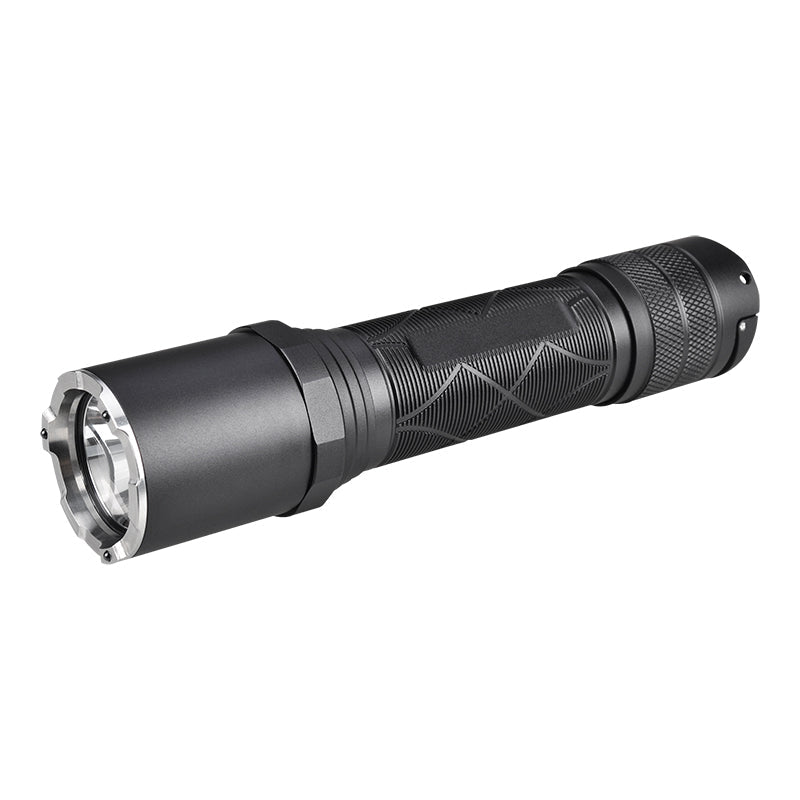
A handheld flashlight lets you aim light independently of your head. That is useful when checking a path, examining equipment, or directing illumination away from another angler.
A focused beam suits occasional distance checks. A wider beam is often easier to use around a tackle station.
For many anglers, the most practical combination is a headlamp for routine work and a separate flashlight for backup and selective distance lighting.
Underwater Fishing Lights for Attraction
Submersible fishing lights serve a different purpose. Commercial systems commonly use green or white light to encourage activity around docks or boats.
Specialist suppliers describe a food-chain effect: light attracts plankton, baitfish gather, and predators may follow. However, that explanation is not a guarantee of improved catches at every location.
Treat underwater lighting as a supplementary fishing tool, not a replacement for personal illumination or required vessel lighting.
How Many Lumens Do You Need for Night Fishing?
There is no single lumen figure that makes a light ideal for every fishing trip. The useful output depends on distance, beam shape, surrounding light, and the task.
Our buying principle is simple: choose control before maximum output.
A powerful light without a comfortable low mode can be less useful than a modest light with well-spaced settings.
| Fishing task | Useful lighting characteristic | What to check |
|---|---|---|
| Tying knots and changing tackle | Low-output, broad illumination | Close-range glare and minimum brightness |
| Walking an access path | Even coverage with usable reach | Visibility around your feet and ahead |
| Checking a distant shoreline | More concentrated beam | Beam intensity and published distance |
| Organizing boat equipment | Controlled, downward-facing light | Spill into other people’s eyes |
| Managing an unexpected failure | Independent backup light | Accessibility and remaining battery |
Use this table as a task-based selection guide, not a universal brightness standard.
When possible, test a light at the distance you actually work. A beam that looks impressive against a distant wall may be uncomfortable when reflected from a pale tackle tray nearby.
Read Fishing Flashlight Specifications Without Being Misled
A specification sheet becomes more useful when you understand what each number describes—and what it does not.
Lumens, Beam Intensity, and Distance Are Different
Lumens describe total light output. Beam intensity describes how concentrated the light is in a particular direction. Published beam distance provides another standardized comparison.
These measurements answer different questions.
For close work, smooth coverage may matter more than impressive distance. For occasional checks across open space, a more concentrated beam may be useful.
Do not compare fishing flashlights using lumens alone. Look at the beam pattern and the intended task together.
Maximum Brightness Is Not Maximum Runtime
A listing may advertise both a high maximum output and a very long runtime. Those figures should not be assumed to apply simultaneously.
Under the commonly published ANSI FL1 runtime definition, testing continues until output falls to 10% of its initial measured value. A long runtime therefore does not mean the light maintains its starting brightness throughout that period.
Before buying, ask:
-
Which output mode produced the advertised runtime?
-
Is sustained-output information available?
-
Does the manufacturer publish a runtime graph?
-
Which battery was used for the test?
-
Can you replace or recharge that battery conveniently?
For an evening trip, useful illumination over the required period matters more than the largest number on the packaging.
Waterproof Ratings Need Context
Water resistance deserves attention around rain, spray, wet tackle, and accidental drops.
IPX7 describes temporary immersion under standardized conditions. IPX8 refers to immersion under manufacturer-specified conditions that are more demanding than IPX7.
Do not read IPX8 as unlimited underwater use. Check the stated depth, duration, and operating instructions.
Also distinguish accidental-immersion protection from suitability for continuous underwater fishing. A personal flashlight and a purpose-built submersible attraction light are not automatically interchangeable.

Choose the Best Night Fishing Lights for Your Location
Your fishing environment should shape the lighting setup. Start with the work you need to perform, then select the equipment.
Bank and Shore Fishing
For bank fishing, prioritize hands-free close illumination and a separate light for access routes.
A practical setup includes:
-
A comfortable headlamp with an accessible low mode.
-
A handheld flashlight carried where it can be reached quickly.
-
Backup power stored away from wet tackle.
-
A secure carrying method appropriate to the light.
Before settling into your spot, identify the return route. Your lighting needs may change when you are carrying equipment rather than arriving with both hands free.
Dock and Pier Fishing
On a dock or pier, controlled illumination helps you work without unnecessarily lighting other anglers.
Choose a low setting for tackle handling, and direct stronger light only where needed.
If considering an underwater fishing light, check the operator’s rules and local requirements before installation or use. Do not assume that permission to fish includes permission to attach electrical equipment.
Position personal lights so that you can reach them without leaning over the water.
Boat Fishing
On a boat, personal task lighting and navigation lighting have different roles.
The U.S. Coast Guard warns that some decorative, underwater, and other lighting installations can conflict with navigation-light requirements.
Do not assume a fishing flashlight replaces the lights required for your particular vessel and situation. Check the applicable rules, and keep working lights from obscuring or confusing navigation lights.
Plan where the headlamp, handheld backup, and spare power will sit before leaving the dock.
Green, Red, or White: Which Fishing Light Color Is Best?
Color should follow the purpose of the light, not a blanket claim that one option is best for every angler.
White Light for General Tasks
White light is a practical starting point for inspecting tackle, preparing equipment, and examining the area around you.
Prioritize a comfortable beam and useful brightness settings before paying extra for multiple colors.
If most of your lighting needs involve knots, hooks, bags, and access paths, a straightforward white-light setup may cover the essential work.
Green Light for Underwater Attraction
Green underwater fishing lights are widely marketed for attracting plankton and baitfish. White attraction lights are also available.
Supplier guidance can help explain intended installation and use, but commercial claims should not be treated as independent evidence that a particular color always catches more fish.
Choose a system for its stated application, installation requirements, power supply, and documented operating limits—not promises of guaranteed results.
Red Light as an Optional Feature
Treat a red mode as an additional tool, not an automatic requirement.
If you are considering one, compare how easily you can complete your actual tasks under red and white illumination.
A poorly placed switch or an uncomfortable beam can matter more than the availability of another color. Usability should remain the deciding factor.
A Five-Step Test Before Your First Night Fishing Trip
Specifications help narrow the shortlist. A simple practical check helps reveal whether the light fits your routine.
This is a usability check, not a substitute for laboratory testing.
1. Test Close-Range Work
In a dark setting, open your tackle box and tie a familiar knot.
Check whether the lowest setting provides enough visibility without uncomfortable reflections. Adjust the headlamp angle rather than immediately increasing brightness.
2. Check the Controls
Operate the light with the gloves you intend to wear.
Confirm that you can turn it on, select a low mode, and switch it off without repeatedly activating an unwanted setting.
Controls that feel easy indoors may be awkward when your hands are occupied.
3. Assess Comfort and Carry
Wear the headlamp while completing normal preparation tasks.
Check for pressure points, slipping, and unwanted beam movement. For a handheld light, confirm that its clip, holster, or carrying position suits your clothing and equipment.
4. Check Useful Runtime
Run the light in the mode you expect to use most.
Observe whether the output remains adequate for your task. Do not describe this informal check as a certified runtime test; its purpose is to inform your own battery plan.
5. Rehearse a Lighting Failure
Switch off your primary light and retrieve the backup.
If you cannot find it easily, change its storage position. A spare light only helps when you can reach it without relying on the failed one.
What Tactical-Light Experience Adds to Fishing-Light Selection
At RichFire®, our background includes weapon flashlights, tactical lights, and laser aiming devices. The relevant connection to fishing is disciplined attention to controls, construction, and clearly stated performance.
It is not a reason to treat every tactical product as fishing equipment.
For fishing use, evaluate an independently carried handheld light on its own merits. A weapon-mounted configuration or laser aiming device does not replace a general-purpose fishing light.
Useful purchasing questions include:
-
Are the specifications clearly explained?
-
Is there a practical low mode?
-
Are water-resistance conditions stated?
-
Are batteries and charging requirements identified?
-
Are warranty and return terms easy to find?
RichFire® offers a 30-day return period and a two-year warranty, subject to the applicable policy terms. Review those terms alongside the specifications rather than treating warranty length as proof of suitability.
Build a Fishing-Light Setup Around Real Tasks
Choose your night fishing lights in this order: hands-free task lighting, useful beam control, documented runtime, appropriate water resistance, and an accessible backup.
Then consider optional features.
Explore RichFire® handheld lighting options and compare each model against your fishing checklist. Before ordering, confirm its output modes, battery requirements, and water-resistance conditions, and review the 30-day return and two-year warranty terms.

Frequently Asked Questions About Fishing Lights
What Is the Best Light Setup for Night Fishing?
For many situations, start with a headlamp for hands-free tasks and a separate handheld flashlight for backup. Add an underwater attraction light only if it suits your fishing method, location, and permitted use.
Is a Headlamp Better Than a Flashlight for Fishing?
A headlamp is usually more convenient when both hands are occupied. A flashlight offers independent aiming. They solve different problems, so carrying both can be more practical than choosing one exclusively.
Are Brighter Fishing Lights Always Better?
No. More output is not automatically more useful at close range. Beam shape, minimum brightness, controls, and useful runtime all influence whether a light suits the task.
Can I Use a Waterproof Flashlight Underwater?
Only within its documented limits. Check the exact immersion conditions and operating instructions. Do not assume an accidental-immersion rating makes a flashlight suitable for prolonged underwater fishing use.
Do Green Fishing Lights Guarantee More Fish?
No. Specialist suppliers describe green lighting as a way to encourage plankton and baitfish activity, but that does not establish guaranteed catches. Treat attraction lighting as one part of the overall fishing setup.
How Should I Plan Battery Backup?
Base the plan on your expected operating mode and trip duration. Carry an independent backup light and appropriate spare power, then check both before departure. Avoid relying solely on the longest runtime printed in a listing.
The goal is not the most complicated setup. It is dependable illumination you understand before darkness arrives.
References
1. Fenix Lighting. “Choosing The Best Fishing Lights For Your Night Adventures.” Original article reviewed for topic coverage and restructuring; its product descriptions are not presented as RichFire® specifications. https://www.fenixlighting.com/blogs/news/choosing-the-best-fishing-lights-for-your-night-adventures
2. Peli. “Flashlight ANSI FL1 Standards.” Manufacturer explanation of light output, runtime, beam performance, and water-penetration ratings. https://www.peli.com/eu/en/support/flashlight-ansi-standards/
3. Streamlight, hosted by Anixter. “ANSI/NEMA-FL1 Standard.” Technical presentation explaining standardized runtime measurement and water-resistance categories. https://www.anixter.com/content/dam/Suppliers/Streamlight/ansi-pres.pdf
4. U.S. Coast Guard. “Marine Safety Alert issued for Navigational Lights.” Official warning concerning unapproved navigation lights and potentially conflicting decorative or underwater lighting. https://uscgboating.org/multimedia/news-detail.php?id=512
5. Underwater Green Fishing Lights. “Frequently Asked Questions.” Commercial supplier explanation of intended attraction-light applications and the proposed plankton–baitfish relationship; not independent proof of catch improvement. https://underwatergreenfishinglights.com/pages/frequently-asked-questions
6. Fishing Lights Etc. “Does Color Matter for Fishing Lights and Dock Lights?” Commercial discussion of green and white attraction lights; used as industry context rather than evidence of a universally superior color. https://www.fishinglightsetc.com/blog/does-color-matter-for-fishing-lights/
Hot Tags: Fishing Lights, Night Fishing Lights, Best Fishing Lights, Fishing Headlamp, Fishing Flashlight, Rechargeable Fishing Headlamp, Waterproof Fishing Flashlight, Underwater Fishing Lights, Green Fishing Lights, Submersible Fishing Lights