
Content Menu
● Tactical Flashlight vs Searchlight: Key Differences at a Glance
● What Is a Tactical Flashlight for Property Inspections?
>> Where a Tactical Flashlight Works Best
>> Handheld Lights and Weapon Flashlights Are Different Tools
● What Is a Searchlight for Large Properties?
>> Where a Searchlight Adds Value
● Lumens, Candela, and Beam Distance: Compare the Right Numbers
>> Lumens Describe Total Output
>> Candela Describes Peak Beam Intensity
>> Advertised Throw Is Not Identification Distance
● Why Sustained Output Matters More Than Turbo Mode
>> Read Runtime Claims Carefully
>> Do Not Combine Separate Maximum Ratings
● Choose by Inspection Distance, Not Acreage Alone
>> Step 1: Identify Your Critical Viewing Points
>> Step 2: Separate Walking Tasks from Observation Tasks
>> Step 3: Define What You Must See
● An Illustrative Large-Property Lighting Plan
● A Practical Nighttime Acceptance Test
● Durability, Battery Logistics, and Ownership Cost
● Which Light Should You Choose?
>> Is a tactical flashlight powerful enough for a large property?
>> Is a searchlight always brighter than a tactical flashlight?
>> How many lumens do I need for property inspections?
>> Can a flashlight with a 1,000-meter rating identify objects at 1,000 meters?
>> Should I use a weapon-mounted flashlight for routine property checks?
>> Is one large searchlight better than two smaller lights?
Choosing a tactical flashlight vs searchlight for large properties comes down to one practical question: do you need a light you can carry throughout an inspection, or a dedicated tool for examining distant areas? A tactical flashlight usually favors portability and quick operation. A searchlight typically prioritizes reach, broader illumination options, or greater battery capacity.
For many property owners, the most effective arrangement is layered: a compact handheld light for routine checks and a searchlight for open fields, long driveways, and distant boundaries.
At RichFire®, our perspective comes from 12 years of experience selling high-performance tactical lights, weapon flashlights, and laser aiming devices, alongside experience in product design, precision manufacturing, and rigorous testing. Our recommendation is straightforward: choose around your property’s actual visibility challenges—not the largest lumen number.

Tactical Flashlight vs Searchlight: Key Differences at a Glance
These categories overlap. Some compact tactical flashlights produce tightly focused, long-reaching beams, while some searchlights offer wide floodlighting. Compare individual specifications rather than assuming the product name guarantees performance.
| Comparison factor | Tactical flashlight | Searchlight |
|---|---|---|
| Primary advantage | Convenient everyday carry | Dedicated distance or area inspection |
| Typical format | Compact handheld body | Larger handheld body, often with a handle or strap |
| Beam characteristics | Focused center with varying peripheral spill | Concentrated spotlight, floodlight, or selectable beams |
| Carrying comfort | Generally better for walking rounds | May become tiring during extended handheld use |
| Controls to prioritize | Accessible switch and predictable modes | Easy beam selection and readable battery information |
| Battery considerations | Compact cells and convenient replacement or charging | Larger packs, potentially longer recharge times |
| Best property tasks | Doors, gates, paths, sheds, and nearby equipment | Fields, distant fence lines, and open yards |
| Main limitation | Compact size can constrain heat management and battery capacity | Size and weight can discourage everyday carry |
My starting point would be the light you will actually take outside. Excellent specifications offer little value if the flashlight stays indoors because carrying it feels inconvenient.
What Is a Tactical Flashlight for Property Inspections?
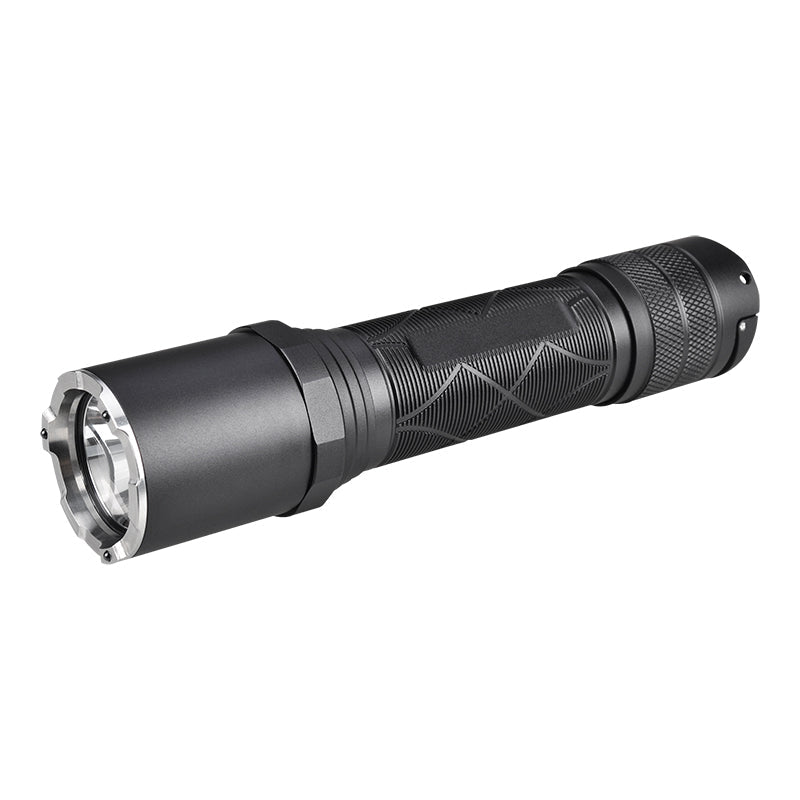
A tactical flashlight generally emphasizes accessible controls, a secure grip, portability, and durable construction. However, “tactical” is not a universal performance certification. Water resistance, impact resistance, beam intensity, and runtime still require separate verification.
For large-property inspections, a handheld tactical light is useful when you frequently switch between walking, opening gates, reading labels, and examining nearby structures.
Where a Tactical Flashlight Works Best
Consider a compact handheld model when your rounds involve:
-
Walking between a house, workshop, and garage.
-
Checking gate hardware and door locks.
-
Inspecting paths, steps, and uneven ground.
-
Looking beneath vehicles or equipment.
-
Carrying a backup light during longer inspections.
Peripheral spill matters here. A narrow central hotspot may illuminate a distant object effectively while leaving nearby obstacles harder to see.
Handheld Lights and Weapon Flashlights Are Different Tools
A weapon-mounted flashlight should not serve as a general-purpose property inspection light. Using it to illuminate an unidentified sound or object also points the firearm in that direction.
Keep a separate handheld light for ordinary observation and maintenance. Likewise, a laser aiming device does not replace illumination: it does not reveal the surrounding scene, obstacles, or background.
What Is a Searchlight for Large Properties?
A searchlight is designed primarily for directed observation over distance, broad-area illumination, or both. Many models use larger reflectors, larger battery packs, and carrying aids such as handles or shoulder straps.
The distinction is about capability rather than size alone. A flood-oriented searchlight and a tightly focused spotlight can behave very differently outdoors.
Where a Searchlight Adds Value
A searchlight becomes useful when you need to examine:
-
Long driveways and remote entrances.
-
Open fields and pasture boundaries.
-
Distant outbuildings.
-
Large equipment-storage yards.
-
Storm damage visible from a safe observation point.
It does not illuminate through vegetation, buildings, or terrain. If trees block your boundary, changing your viewing position may help more than buying a brighter light.
For mixed properties, selectable spot and flood modes can be valuable: spot for distant observation, flood for nearby surroundings.
Lumens, Candela, and Beam Distance: Compare the Right Numbers
The biggest purchasing mistake is treating lumens as a complete measure of outdoor usefulness.
Lumens Describe Total Output
Lumens measure total emitted visible light. Higher output can support wider illumination, but it does not automatically mean greater reach.
A broad floodlight can distribute substantial light across a nearby yard without concentrating enough intensity on a distant gate.
Candela Describes Peak Beam Intensity
Candela measures intensity in the brightest direction of the beam. It is particularly relevant when comparing lights for long driveways, fence lines, and remote structures.
A useful manufacturer example illustrates the difference. Streamlight’s Dualie 2AA lists both its spot and flood modes at 115 lumens. Yet the spot mode is rated at 3,100 candela and 111 meters, compared with 75 candela and 17 meters for the flood mode.
Equal lumens clearly do not guarantee equal reach.
Advertised Throw Is Not Identification Distance
Under the ANSI/PLATO FL 1 framework, beam distance represents the distance at which illumination reaches 0.25 lux.
That is a standardized comparison point—not a promise that you can recognize a face, read a sign, or assess damage at that distance.
Actual visibility depends on:
-
Object size, contrast, and reflectivity.
-
Background lighting.
-
Rain, mist, and airborne particles.
-
Beam width and foreground glare.
-
Your eyesight and viewing position.
Treat advertised throw as a screening specification. Confirm usable visibility at your own inspection points.

Why Sustained Output Matters More Than Turbo Mode
A light that briefly delivers impressive output may not maintain it throughout a property inspection.
High-output LEDs generate heat. Depending on the design, a flashlight may reduce brightness automatically to manage temperature. Battery condition and ambient temperature also affect performance.
Read Runtime Claims Carefully
Standardized runtime figures do not necessarily mean constant brightness. Manufacturer explanations of FL 1 testing describe runtime ending when output falls to 10% of its initial reading.
Consequently, “two hours” can include substantial time at reduced output.
Before buying, look for:
-
A runtime graph, rather than duration alone.
-
Output on medium or sustained operating modes.
-
Explanations of thermal step-down.
-
Battery requirements and replacement availability.
-
Charging time and charging-equipment requirements.
For routine rounds, I would prioritize a dependable working mode over a spectacular maximum setting.
Do Not Combine Separate Maximum Ratings
The Fenix LR60R illustrates why specifications need context. Its published specifications include 21,000 maximum lumens, 1,085 meters of maximum beam distance, and 113 hours of maximum runtime.
Those figures do not describe one continuous operating condition. The manufacturer’s mode table assigns the 113-hour runtime to its 50-lumen spotlight setting.
Compare output, distance, and runtime within the same mode.
Choose by Inspection Distance, Not Acreage Alone
Acreage is a poor substitute for a visibility plan. A wooded property can require mostly short-range lighting, while a smaller open site may have one long, unobstructed approach.
Step 1: Identify Your Critical Viewing Points
List the locations where visibility matters:
-
Main entrance.
-
Workshop door.
-
Livestock enclosure.
-
Remote storage building.
-
Driveway bend.
-
Boundary gate.
Then estimate or measure the viewing distance from your normal inspection position.
Step 2: Separate Walking Tasks from Observation Tasks
Use a handheld tactical flashlight where you need mobility and convenient close-range illumination.
Consider a searchlight where you regularly stop to examine a distant area. If you need both functions, a two-light arrangement may be more practical than one oversized compromise.
Step 3: Define What You Must See
“Seeing the gate” and “seeing whether the gate latch is damaged” are different requirements.
Write a specific inspection question for each location. This creates a better purchasing test than simply asking whether the beam looks bright.
An Illustrative Large-Property Lighting Plan
Consider a hypothetical property with a house, workshop, orchard, and distant access gate. This is a planning example, not a reported customer test.
| Location | Inspection need | Practical lighting choice |
|---|---|---|
| House-to-workshop path | See footing and nearby obstacles | Handheld light with useful spill |
| Workshop entrance | Examine locks and door hardware | Controllable medium or low output |
| Orchard rows | Observe around vegetation | Portable light plus changes in viewing position |
| Distant access gate | Examine an unobstructed viewing area | High-candela flashlight or searchlight |
| Equipment repair point | Maintain illumination while working | Separate work light or stable area-light setup |
The lesson is that no beam solves every task. Distance lighting, walking illumination, and hands-free repair lighting are related but distinct needs.
A searchlight can supplement your everyday flashlight without replacing it.
A Practical Nighttime Acceptance Test
The most valuable comparison happens on your property, under controlled and safe conditions.
Use this procedure before committing to a light for regular service:
-
Charge each light fully using approved equipment.
-
Choose several known inspection points at different distances.
-
Compare usable working modes, not only turbo.
-
Operate the lights for 15–20 minutes before repeating the comparison.
-
Examine both distant detail and nearby footing.
-
Try the controls with your normal outdoor gloves.
-
Record visibility, carrying comfort, heat, and remaining battery indication.
The 15–20-minute interval is a practical screening suggestion, not a standardized laboratory test. Its purpose is to reveal performance changes that a brief demonstration can miss.
Keep cameras in manual settings if documenting beams. Automatic exposure can make unequal lights look deceptively similar.
Never direct testing beams toward roads, neighboring windows, people, or animals.
Durability, Battery Logistics, and Ownership Cost
A reliable property light needs more than a strong beam.
Check the stated water-resistance and impact-resistance conditions. “Waterproof” without a defined rating or test depth tells you little. Likewise, an impact rating does not establish that every component will survive every fall.
For battery planning, ask:
-
Can you obtain replacement cells or packs?
-
Is charging convenient where the light is stored?
-
Can you inspect charge status before leaving?
-
Does the manufacturer specify battery compatibility?
-
Is there a backup light available during charging?
Compare total ownership cost, including batteries, chargers, carrying accessories, and replacement availability.
A return period helps you evaluate suitability; a warranty addresses covered product problems. They serve different purposes, and neither substitutes for choosing the right beam.
Which Light Should You Choose?
Choose a tactical flashlight if most inspections involve walking, nearby structures, gates, and equipment—and carrying comfort is essential.
Choose a searchlight if distant, unobstructed observation is a recurring task and you can accommodate the added size and weight.
Choose both if your property combines close maintenance work with long-range inspection. Keep the compact light accessible and reserve the searchlight for tasks that genuinely require it.
At RichFire®, we support store purchases with a 30-day return period and a two-year warranty. Contact our team with your longest inspection distance, typical round duration, and preferred charging setup. Ask for the relevant beam-intensity and runtime information before selecting a model, and review the applicable return and warranty terms.

Frequently Asked Questions
Is a tactical flashlight powerful enough for a large property?
Sometimes. A high-candela handheld light may suit your longest clear viewing distance. Acreage alone does not determine the answer. Evaluate the actual inspection task, beam pattern, and sustained output.
Is a searchlight always brighter than a tactical flashlight?
No. Product categories overlap, and “brighter” can mean higher total output or greater beam intensity. Compare lumens for total output and candela for concentrated intensity.
How many lumens do I need for property inspections?
There is no universal number. Nearby maintenance, walking, and distant observation require different beam patterns. Compare working-mode output, candela, and visibility at your actual inspection points.
Can a flashlight with a 1,000-meter rating identify objects at 1,000 meters?
Not necessarily. Standardized beam distance uses a 0.25-lux endpoint. Recognizing useful detail depends on the object, conditions, background, and observer—not the distance rating alone.
Should I use a weapon-mounted flashlight for routine property checks?
Use a separate handheld light for general inspection. A weapon-mounted light ties illumination to firearm direction, making it unsuitable for casually examining unidentified objects or ordinary maintenance tasks.
Is one large searchlight better than two smaller lights?
Not automatically. A dedicated searchlight can improve distant observation, while a compact backup provides convenient close-range illumination and redundancy. Choose around your tasks rather than device count.
References
1. Streamlight — FAQs. Manufacturer explanations of lumens, candela, beam focus, and application-based light selection.
2. Streamlight — ANSI Information. Definitions of light output, peak beam intensity, and the 0.25-lux beam-distance endpoint; explanation of voluntary manufacturer testing.
3. Streamlight — ANSI/PLATO FL 1 Standard Presentation. Technical overview of standardized performance measurements and beam-distance calculations.
4. Streamlight — Dualie 2AA Product Fact Sheet. Published spot and flood specifications demonstrating different beam intensity and distance at equal lumen output.
5. Fenix Lighting — LR60R Search Flashlight. Manufacturer specifications for maximum output, beam distance, runtime, battery pack, weight, and operating modes.
6. Fenix Lighting — Fenix’s Top 3 Brightest Flashlights of 2024. LR60R mode table showing the relationship between output, intensity, beam distance, and runtime, including the 50-lumen, 113-hour setting.
7. Fenix Lighting — PD35R Custom Engraved Flashlight. Manufacturer explanation of temperature-related output reduction and the FL 1 runtime endpoint.
Hot Tags: Tactical Flashlight, Rechargeable Flashlight, LED Flashlight, High Lumen Flashlight, Long Range Flashlight, Rechargeable Spotlight, Handheld Searchlight, Outdoor Flashlight, Waterproof Flashlight, Rechargeable Tactical Flashlight