
Content Menu
● How Does a UV Flashlight Work?
>> UV Inspection Is Not UV Disinfection
● 365 nm vs. 395 nm UV Flashlights: Which Should You Choose?
● Practical UV Flashlight Uses Around the Home and Workplace
>> 1. Locating Suspected Pet Stains
>> 2. Checking Banknote Security Features
>> 3. Inspecting Compatible Fluorescent Leak-Detection Dye
>> 4. Examining UV Security Markings
>> 5. Exploring Fluorescent Materials
● What a UV Flashlight Cannot Reliably Confirm
>> It Cannot Diagnose Mold or Water Damage
>> It Cannot Certify a Hotel Room as Pest-Free
>> It Cannot Identify Every Biological Residue
● A Repeatable UV Inspection Workflow
>> Step 1: Define the Question
>> Step 2: Establish a White-Light Baseline
>> Step 3: Control the Viewing Conditions
>> Step 4: Compare Before Concluding
● How to Choose a UV Flashlight for Your Application
● UV Flashlight Safety: Protect Eyes and Skin
● Choose Purpose-Built Lighting with RichFire®
>> What Is a UV Flashlight Used For?
>> Is 365 nm Better Than 395 nm?
>> Can a UV Flashlight Detect Mold?
>> Can a UV Flashlight Kill Germs?
>> Does Every Genuine Banknote Glow?
>> Why Does My UV Flashlight Show Mostly Purple Light?
>> Can I Use a Tactical Flashlight for UV Inspection?
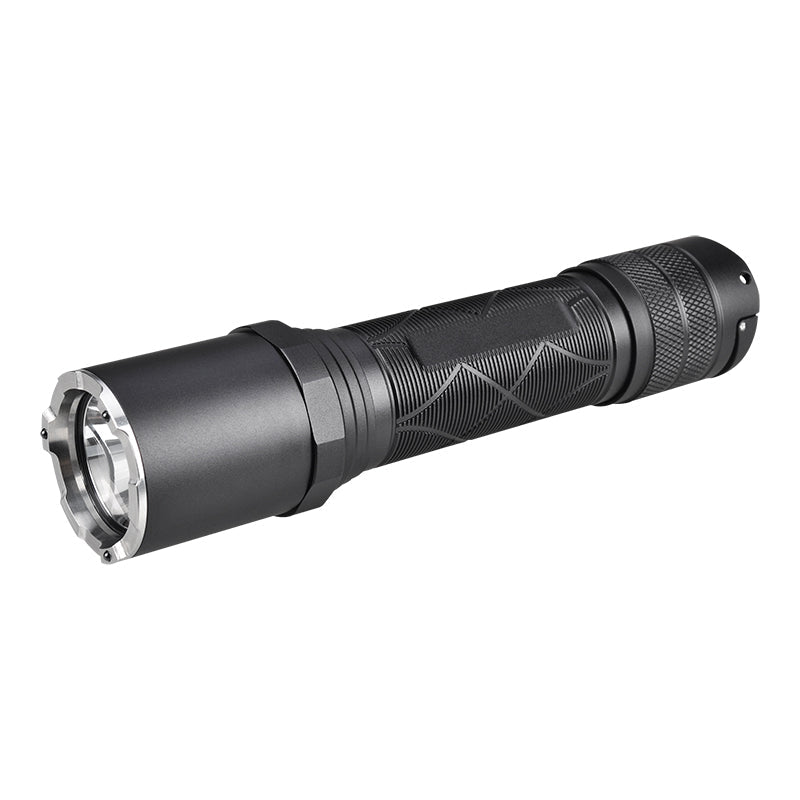
A UV flashlight can reveal fluorescent details that an ordinary flashlight misses. From locating suspected pet stains to inspecting fluorescent leak-detection dye, practical UV flashlight uses extend well beyond novelty lighting. The key is knowing what a glowing mark can—and cannot—tell you.
At RichFire®, our approach to choosing inspection lighting starts with a simple question: what do you need to identify? With 12 years of experience selling weapon flashlights, high-performance tactical lights, and laser sights, we understand why purpose matters more than an impressive specification.
This guide explains how UV flashlights work, compares common wavelengths, and provides a repeatable inspection process. Most importantly, it separates useful observations from conclusions that require additional evidence.

How Does a UV Flashlight Work?
A UV flashlight directs ultraviolet radiation onto a surface. Certain substances absorb that energy and release visible light, producing fluorescence. That glow can make a stain, security feature, or inspection dye stand out against its surroundings.
Many handheld inspection lights operate in the UVA range. UVA spans approximately 315–400 nanometers; common flashlight wavelengths include 365 nm and 395 nm. The wavelength describes the emitted radiation, not the flashlight’s brightness or overall quality.
Think of a UV flashlight as a screening tool. It helps you locate something worth examining, but it does not automatically identify the substance.
A glowing carpet patch may be a suspected pet stain. It may also be cleaning residue or another fluorescent material. Likewise, an unexpected mark on a document is a reason to investigate—not an immediate verdict.
UV Inspection Is Not UV Disinfection
A handheld UVA inspection flashlight should not be treated as a sterilizer.
Fluorescence inspection and germicidal treatment are different applications. Germicidal systems require suitable wavelengths, exposure conditions, and safety controls. The FDA has warned that certain consumer UVC wands can injure skin and eyes within seconds. Do not substitute an inspection flashlight for an established cleaning or disinfection method.
365 nm vs. 395 nm UV Flashlights: Which Should You Choose?
For many inspection tasks, the useful question is not “Which light looks brighter?” but “Which light makes the target easier to distinguish?”
A 395 nm flashlight generally produces more noticeable violet light. A 365 nm model typically produces less visible violet output, which can make fluorescence easier to distinguish. However, performance still depends on the LED, optical design, filter, target material, and working distance. Independent flashlight comparisons show that wavelength alone does not guarantee useful results.
| Buying consideration | 365 nm UV flashlight | 395 nm UV flashlight |
|---|---|---|
| Visible violet output | Usually less noticeable | Usually more noticeable |
| Inspection contrast | Often helpful for subtle fluorescent details | Visible violet light may obscure weaker details |
| Suitable starting point | Detailed inspection and compatible security features | General fluorescence exploration |
| Important limitation | Not every material responds strongly | A brighter purple beam does not prove better detection |
Some 365 nm flashlights include a filter intended to reduce unwanted visible light. Check the actual product specification rather than assuming that every 365 nm model includes one.
Before buying, identify the intended target. For security documents or inspection dyes, follow the relevant issuer’s or dye manufacturer’s wavelength guidance.
Practical UV Flashlight Uses Around the Home and Workplace
1. Locating Suspected Pet Stains
A UV flashlight can help locate some fluorescent pet-related residues on carpets, upholstery, and hard surfaces. It is particularly useful when you know an accident occurred but cannot find the affected area under ordinary lighting.
For a more controlled inspection:
-
Inspect the area with white light first.
-
Reduce ambient lighting.
-
Scan slowly, keeping the beam at a consistent distance.
-
Mark suspicious patches with a removable marker placed nearby.
-
Compare them with surrounding material.
-
Clean using a method suitable for the surface.
Do not assume every glowing patch is urine. Treat the finding as a suspected stain, then consider its location, odor, appearance, and cleaning history.
Avoid judging cleaning success by fluorescence alone. A remaining glow does not necessarily establish that contamination remains, and an absent glow does not prove that the surface is clean.
2. Checking Banknote Security Features
UV illumination can reveal specific fluorescent banknote features.
For example, the U.S. Currency Education Program states that the security thread in the illustrated $20 note glows green under ultraviolet light. The same guidance also describes other features that should be checked, including the watermark and color-shifting numeral.
A sensible checking sequence is:
-
Identify the currency, denomination, and note design.
-
Consult the issuing authority’s security guidance.
-
Examine the expected UV feature.
-
Check additional features under ordinary or transmitted light.
-
Escalate suspicious notes through your workplace procedure.
Do not apply one currency’s rules to another. Features can differ by denomination and design series. Also, not every genuine U.S. denomination has a security thread; official guidance excludes the $1 and $2 notes from that feature.
3. Inspecting Compatible Fluorescent Leak-Detection Dye
Leak detection is one of the strongest professional applications for UV inspection.
The important detail is that the flashlight usually reveals a compatible fluorescent tracer dye—not an otherwise invisible leak by itself. Specialized dyes are used in applications including refrigeration, hydraulic equipment, and industrial fluid systems.
A maintenance inspection generally involves:
-
Selecting a dye approved for the specific system.
-
Following the manufacturer’s dosing and application instructions.
-
Allowing the dye to circulate as instructed.
-
Inspecting accessible components with a compatible lamp.
-
Documenting fluorescent traces and confirming the leak source.
A UV flashlight does not replace technical training. Refrigerant circuits, pressurized equipment, and electrical installations require appropriate procedures.
Do not add a generic fluorescent liquid to machinery. Compatibility with the host fluid and equipment matters.
4. Examining UV Security Markings
Some identification documents, access credentials, and event passes incorporate UV-reactive markings. A flashlight can help reveal those features when the document design includes them.
The useful comparison is against the expected genuine design, not against a general assumption that “real documents glow.”
For workplace checks, use an approved reference and established procedure. A missing or unusual feature should trigger further review rather than an unsupported accusation.
5. Exploring Fluorescent Materials
UV lighting can also make certain minerals and other fluorescent materials easier to observe. This creates useful opportunities for collecting, demonstrations, and visual exploration.
Keep the conclusion modest: fluorescence is an observable property, not a complete identification test. Materials may respond differently to different wavelengths, and a non-glowing specimen is not necessarily unusual or inauthentic.
For collectors, the best purchase starts with the specimen’s requirements rather than a generic recommendation for the most powerful flashlight.

What a UV Flashlight Cannot Reliably Confirm
The biggest weakness in many UV flashlight guides is overconfidence. They describe a glow as though it were a laboratory result.
It Cannot Diagnose Mold or Water Damage
Do not use fluorescence to identify mold species, determine toxicity, or declare a building safe.
The Environmental Protection Agency emphasizes visual inspection, moisture investigation, and appropriate professional assessment. Where visible mold is present, sampling is often unnecessary; specialist testing should answer a defined question. A UV flashlight is not a substitute for that process.
If a wall looks stained or smells damp, investigate the moisture source. Do not rely on whether it glows.
It Cannot Certify a Hotel Room as Pest-Free
A quick UV scan should not be presented as proof that a mattress or room is free of bedbugs.
Even the original article’s broad pest-checking suggestions do not establish a validated inspection protocol. Use UV observations only as supplementary clues, not as a pass-or-fail cleanliness certificate.
It Cannot Identify Every Biological Residue
An unexplained fluorescent mark cannot establish whose residue it is, how old it is, or whether it presents a health risk.
For household use, the practical response is careful inspection and suitable cleaning. For workplace or forensic situations, preserve the relevant procedures and avoid unsupported conclusions.
A Repeatable UV Inspection Workflow
A consistent method is more useful than randomly sweeping a beam across a room.
Step 1: Define the Question
Decide what you are looking for: a suspected stain, a documented security feature, or a compatible tracer dye.
This determines whether UV illumination is appropriate.
Step 2: Establish a White-Light Baseline
Look for visible discoloration, dampness, damage, or residue first. UV findings become easier to interpret when you already understand the surface.
Step 3: Control the Viewing Conditions
Reduce ambient lighting where practical. Keep your distance and scanning angle reasonably consistent.
For currency checks, independent testing indicates that excessive brightness or a concentrated beam can make some details harder to examine.
Step 4: Compare Before Concluding
Where available, compare the finding with a known reference: an unaffected area, an official security illustration, or the dye manufacturer’s instructions.
Step 5: Record and Verify
Photograph or note the location, viewing conditions, and relevant product settings. Describe what you observed without overstating what it proves.
“Fluorescent trace near fitting” is more useful than “confirmed leak” when confirmation has not yet occurred.
How to Choose a UV Flashlight for Your Application
Start with task compatibility, then evaluate everyday usability.
| Feature | What to check |
|---|---|
| Wavelength | Suitability for the intended target |
| Optical filter | Whether one is included and what it does |
| Beam pattern | Coverage appropriate for the inspection area |
| Runtime | Published runtime for the UV mode |
| Battery system | Charging method and replacement availability |
| Construction | Documented ingress and impact ratings |
| Controls | Easy, deliberate operation |
| Support | Clear returns and warranty terms |
Do not confuse white-light lumens with UV capability. A dual-mode flashlight may advertise a high lumen figure for its visible beam while listing UV output separately. The original article’s product examples illustrate this distinction.
Likewise, maximum runtime may refer to a low white-light setting rather than continuous UV operation. Read the mode-specific specifications before comparing products.
For hands-free work, a clip, magnetic base, or adjustable head may improve usability. Choose these features around your actual workspace—not simply because they make the specification list longer.
UV Flashlight Safety: Protect Eyes and Skin
UVA is less hazardous than some shorter-wavelength UV sources, but “less hazardous” does not mean harmless. Ultraviolet exposure can affect the eyes and skin, and artificial UV sources require appropriate precautions.
Use these basic safeguards:
-
Never stare into the emitter.
-
Do not direct the beam at people or animals.
-
Avoid unnecessary skin exposure.
-
Keep the light away from children.
-
Follow the manufacturer’s operating instructions.
-
Use appropriate, documented UV protective equipment when required.
-
Exercise particular care around reflective surfaces.
Do not assume tinted eyewear provides the necessary protection. For occupational use, select protection through the relevant workplace risk assessment and equipment documentation.
Choose Purpose-Built Lighting with RichFire®
At RichFire®, we bring 12 years of experience in weapon flashlights, tactical lighting, and laser sights, supported by the product-design, precision-manufacturing, and rigorous-testing experience described by our team.
Our store offers a 30-day return period and a two-year warranty, subject to the applicable policy terms.
Before ordering inspection equipment, identify your task and confirm the required wavelength, operating mode, and specifications. Do not assume a tactical white-light model also provides UV capability.
Explore RichFire® lighting products and choose around your application. If UV inspection is your priority, confirm the relevant model’s availability and documented features before purchasing.

Frequently Asked Questions
What Is a UV Flashlight Used For?
A UV flashlight reveals fluorescence. Common applications include inspecting suspected pet stains, checking documented security features, viewing fluorescent materials, and locating compatible leak-detection dye. Its value depends on the target and the inspection method.
Is 365 nm Better Than 395 nm?
Often, 365 nm offers less visible violet interference. However, the best choice depends on the target, optics, filter, and output. Match the light to the application rather than treating wavelength as a complete quality rating.
Can a UV Flashlight Detect Mold?
It cannot reliably identify or diagnose mold. Investigate visible growth and moisture using appropriate inspection methods. Seek professional assessment when necessary rather than treating fluorescence as confirmation.
Can a UV Flashlight Kill Germs?
Do not treat an ordinary UVA inspection flashlight as a disinfectant. Germicidal UV applications require different performance and safety considerations, and some consumer UVC devices present serious exposure risks.
Does Every Genuine Banknote Glow?
No universal glowing pattern applies to all currencies or denominations. Check the expected features for the exact note. U.S. guidance, for example, states that $1 and $2 notes do not have the security thread described for higher denominations.
Why Does My UV Flashlight Show Mostly Purple Light?
The visible violet component can be prominent, particularly with longer-wavelength models. Strong purple illumination does not necessarily mean strong inspection performance; useful fluorescence contrast matters more.
Can I Use a Tactical Flashlight for UV Inspection?
Only if the model has a documented UV mode suitable for the task. A powerful white-light beam does not provide UV capability, and a laser sight is not a substitute for a UV emitter.
References
1. Fenix Lighting, “Unexpected Ways to Use a UV Flashlight.” Original article used to identify applications and areas requiring stronger limitations. https://www.fenixlighting.com/blogs/news/unexpected-ways-use-uv-flashlight
2. Australian Radiation Protection and Nuclear Safety Agency, “Ultraviolet Radiation” and occupational-exposure guidance. Sources for wavelength classification and exposure precautions. https://www.arpansa.gov.au/understanding-radiation/what-is-radiation/non-ionising-radiation/ultraviolet-radiation | https://www.arpansa.gov.au/understanding-radiation/sources-radiation/occupational-exposure/occupational-exposure-workers
3. U.S. Currency Education Program, “$20 Note” and “Know Your Money.” Official guidance for banknote security features. https://www.uscurrency.gov/denominations/20 | https://www.uscurrency.gov/sites/default/files/downloadable-materials/files/en/know-your-money-en.pdf
4. U.S. Environmental Protection Agency, “Mold Course Chapter 3” and “Is Sampling/Testing for Mold Necessary?” Sources for mold-inspection limitations. https://www.epa.gov/mold/mold-course-chapter-3 | https://www.epa.gov/mold/samplingtesting-mold-necessary
5. U.S. Food and Drug Administration, UV-wand safety communication. Source for consumer UVC exposure warnings. https://www.fda.gov/medical-devices/safety-communications/do-not-use-ultraviolet-uv-wands-give-unsafe-levels-radiation-fda-safety-communication
6. Spectroline, fluorescent leak-detection and industrial-dye guidance. Manufacturer sources for tracer-dye applications and compatibility considerations. https://spectroline.com/ | https://spectroline.com/fluorescent-dyes-for-industrial-leaks/
7. 1Lumen, UV flashlight comparative testing. Secondary source for wavelength, visible-light interference, and practical inspection differences. https://1lumen.com/best-uv-flashlight/
Hot Tags: UV Flashlight, Black Light Flashlight, UV Flashlight Uses, 365nm UV Flashlight, 395nm UV Flashlight, Rechargeable UV Flashlight, Pet Urine Detector, UV Flashlight For Pet Urine, UV Stain Detector, Portable UV Flashlight