
Content Menu
>> Handheld Tactical Flashlights vs. Weapon Flashlights
● Tactical Flashlight Brightness: Lumens, Candela, and Beam Shape
>> Lumens Measure Total Light Output
>> Candela Describes Peak Beam Intensity
>> Advertised Beam Distance Is Not Identification Distance
● Why Sustained Output Matters More Than a Brief Turbo Rating
>> Read Runtime Claims Carefully
>> Understand Thermal Step-Down
● How to Choose a Weapon Light That Actually Fits
>> Confirm the Exact Platform and Mount
>> Evaluate Controls Without Compromising Safety
● Durability: Separate Useful Evidence From Marketing Language
>> Water Resistance Needs Specific Conditions
>> Impact Resistance Is Not Recoil Validation
● Rechargeable Tactical Flashlights: Plan for Power, Not Just Charging
● Laser Sights vs. White Light: Different Tools, Different Responsibilities
>> Check Classification and Labeling
>> Choose Combination Units for Usability
● A Practical Evaluation Checklist Before You Commit
● How to Read Tactical Light Reviews Critically
● Choosing RichFire® With Clear Expectations
>> How Many Lumens Should a Tactical Flashlight Have?
>> Is Higher Candela Always Better?
>> Can a Handheld Flashlight Replace a Weapon Light?
>> Does a Two-Hour Runtime Mean Two Hours at Maximum Brightness?
>> Does a Laser Sight Replace a Flashlight?
>> Are Strobe Modes Essential?
Choosing tactical lights means looking beyond the biggest brightness number. Whether you are comparing handheld tactical flashlights, weapon flashlights, or light-and-laser combinations, the right choice depends on beam quality, dependable controls, practical runtime, and compatibility.
At RichFire®, we bring 12 years of experience selling high-performance tactical lighting and laser aiming devices, supported by experience in product design, precision manufacturing, and rigorous testing. Our approach is straightforward: help customers understand what matters before they buy.
This guide explains how to compare specifications, recognize meaningful product evidence, and select lighting that fits your needs without paying for features you will rarely use.

What Is a Tactical Light?
A tactical light is a portable lighting tool designed around demanding use, accessible controls, and durable construction. The category includes handheld flashlights and purpose-built weapon-mounted lights.
The word “tactical,” however, does not establish a universal level of performance. Two products carrying that label may differ substantially in output stability, switch design, environmental protection, and testing documentation.
Evaluate the individual product rather than relying on its category name.
Handheld Tactical Flashlights vs. Weapon Flashlights
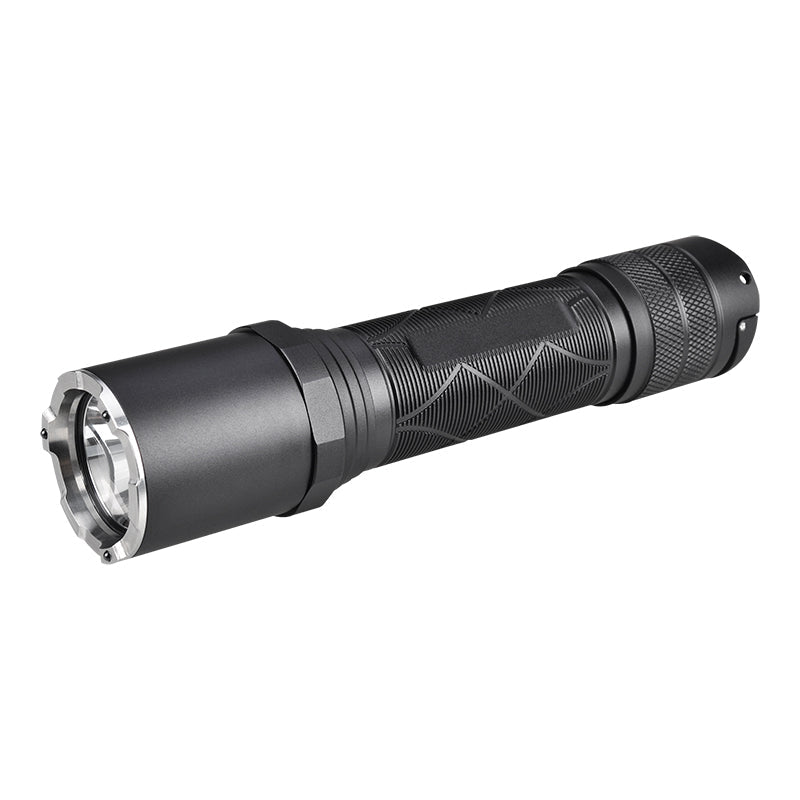
A handheld light provides illumination independently of a firearm. That makes it appropriate for routine inspection, emergency preparation, outdoor use, and other everyday tasks.
Weapon flashlights attach to compatible firearm platforms. Their suitability depends on more than brightness: mounting security, recoil compatibility, control access, and overall fit all matter.
A mounted light should not replace a handheld flashlight for general searching. Keep illumination separate from firearm handling whenever the task does not require a firearm.
| Lighting type | Main advantage | Important buying consideration |
|---|---|---|
| Handheld tactical flashlight | Independent, versatile illumination | Carry comfort and accessible controls |
| Weapon-mounted light | Platform-mounted illumination | Exact fit and documented compatibility |
| Light-and-laser combination | Illumination plus an aiming reference | Separate controls, fit, and laser classification |
Tactical Flashlight Brightness: Lumens, Candela, and Beam Shape
Lumens are only one part of the buying decision. A useful comparison also considers candela, beam distribution, and how performance changes during operation.
Lumens Measure Total Light Output
Lumens describe the total visible light emitted by a source. They help compare overall output, but they do not show where that light goes.
Two flashlights with similar lumen ratings can produce noticeably different beams. One may spread light across a broad area, while another concentrates more of it into a smaller central hotspot.
Neither pattern is automatically better. The useful choice depends on the environment and the task.
Candela Describes Peak Beam Intensity
Candela describes luminous intensity in a particular direction. For flashlight comparisons, peak candela helps explain how concentrated the brightest part of the beam is.
When evaluating a long-range tactical flashlight, examine candela alongside lumens. For general inspection, also consider whether the surrounding spill provides enough context.
A balanced specification sheet should help you understand both total output and beam concentration.
Advertised Beam Distance Is Not Identification Distance
Standardized flashlight beam-distance figures use a low illumination threshold of 0.25 lux. That provides a comparison method, not a promise that you can clearly identify every object at the stated distance.
Weather, background contrast, eyesight, and the object itself affect visibility.
Treat beam distance as a laboratory comparison figure. Do not confuse it with a guaranteed practical viewing distance.
Why Sustained Output Matters More Than a Brief Turbo Rating
One of the most useful questions a buyer can ask is: “What happens after the first few minutes?”
A high maximum output can be helpful, but it does not explain how long that output remains available.
Read Runtime Claims Carefully
Traditional FL 1 runtime reporting measures operation until output falls to 10% of its initial reference level. Consequently, a listed runtime does not necessarily mean the light maintains its advertised maximum brightness throughout that period.
Before comparing rechargeable tactical flashlights, look for:
-
Output-versus-time graphs.
-
Runtime figures for individual modes.
-
Battery type and capacity.
-
Test conditions.
-
Explanations of automatic brightness reductions.
A graph showing stable, useful output can tell you more than a headline claiming several hours of operation.
Understand Thermal Step-Down
High-output lights may reduce brightness as their temperature rises. The timing and extent of that reduction depend on the product, operating conditions, and thermal-control design.
Ask whether the maximum setting is intended for brief use or sustained operation.
The 2025 edition of the ANSI/PLATO FL 1 standard provides an updated framework for reporting flashlight performance. When a seller references a standard, check which edition and which measurements support the claim.
How to Choose a Weapon Light That Actually Fits
Compatibility is a system-level requirement, not a minor accessory detail.
A product described as “rail compatible” may still require a particular mounting key, rail position, or platform configuration.
Confirm the Exact Platform and Mount
Before purchasing a weapon-mounted flashlight, verify:
-
The exact firearm manufacturer, model, and variant.
-
The rail or mounting interface.
-
Any required adapter or mounting key.
-
Available clearance around the installed light.
-
The manufacturer’s installation requirements.
-
Compatibility with any holster you intend to use.
A similar-looking platform is not sufficient evidence of fit. Established manufacturers provide model-specific fit guides precisely because these details vary.
If compatibility information is incomplete, request clarification before ordering.
Evaluate Controls Without Compromising Safety
Controls should be understandable and accessible without encouraging unsafe handling.
For installation or fit checks, follow the firearm and accessory manufacturers’ instructions, ensure the firearm is unloaded, and keep ammunition away from the work area. Seek qualified assistance when uncertain.
Consider whether controls are accessible with either hand, whether mode changes are predictable, and whether accidental activation is reasonably prevented during storage.
Do not assume that more modes create a better user experience.

Durability: Separate Useful Evidence From Marketing Language
Terms such as “rugged” and “professional grade” are descriptions, not test results.
A stronger product listing identifies the relevant test conditions and explains what the results cover.
Water Resistance Needs Specific Conditions
Look for a stated protection rating and any associated immersion depth or duration.
Do not assume that a water-resistance claim covers every situation, including pressurized water, damaged seals, or an open charging cover.
Follow the manufacturer’s conditions and maintenance instructions. Protection depends on the product being used and assembled as specified.
Impact Resistance Is Not Recoil Validation
A drop-test result and a recoil-compatibility statement answer different questions.
Dropping a handheld flashlight does not, by itself, establish that the same product is suitable for weapon mounting.
For weapon flashlights, look for explicit application compatibility and relevant testing information. When that evidence is unavailable, avoid treating a general durability claim as proof.
Rechargeable Tactical Flashlights: Plan for Power, Not Just Charging
Rechargeable designs can simplify routine use, but charging convenience is only one part of dependable ownership.
Ask how the light will remain available during a power interruption, extended outing, or depleted-battery situation.
Compare:
-
Integrated batteries versus user-replaceable cells.
-
Approved battery types.
-
Charging-port accessibility.
-
Whether charging requires removing the light.
-
Battery-status indicators.
-
Manufacturer-approved spare-power options.
Use only the batteries and charging equipment specified for the product. Do not assume that physically similar cells are interchangeable.
For occasional-use equipment, create a regular inspection and charging routine based on the manufacturer’s instructions. A powerful light with an empty battery provides little practical value.
Laser Sights vs. White Light: Different Tools, Different Responsibilities
A laser sight provides an aiming reference. A white light illuminates the surrounding scene. These functions are not interchangeable.
A visible dot does not reveal everything around it and cannot replace adequate illumination or responsible identification.
Check Classification and Labeling
Before buying a laser aiming device, examine its stated laser class, wavelength, output, warning labels, and applicable documentation.
Laser hazards depend on factors including power and exposure. Even lower-powered visible lasers can create visual hazards when viewed directly, and optical aids can increase risk.
Never direct a laser toward eyes, vehicles, or aircraft. Follow the manufacturer’s safety instructions and applicable local requirements.
Do not assume that regulations written for laser pointers automatically resolve the requirements for every aiming device.
Choose Combination Units for Usability
A light-and-laser combination may be convenient, but evaluate the complete package.
Can the illumination and laser functions be selected clearly? Does the unit fit the intended platform? Are the controls and documentation easy to understand?
Avoid choosing a combination device merely because it offers more features on the product page.
A Practical Evaluation Checklist Before You Commit
A structured comparison makes product selection less dependent on advertising.
Use this checklist to document what you know and what still needs verification.
| Evaluation point | What to examine | What to record |
|---|---|---|
| Beam quality | Hotspot, spill, and visual comfort | Suitability for your intended environment |
| Output stability | Published runtime graphs | Step-down behavior and sustained output |
| Controls | Activation and mode selection | Ease of use and accidental activation concerns |
| Compatibility | Exact platform documentation | Required mounts, keys, or adapters |
| Ownership | Charging, maintenance, and service | Ongoing effort and replacement needs |
For handheld beam comparisons, use a safe area without people, animals, traffic, or reflective hazards in the beam. Avoid looking into the emitter.
For mounted products, follow documented safety and installation procedures rather than improvising a test.
This checklist is a buying aid, not a substitute for laboratory testing or professional instruction.
How to Read Tactical Light Reviews Critically
Customer feedback is most useful when it describes specific conditions.
A detailed review might identify the exact product version, battery used, ownership period, and mounting configuration. A short statement such as “extremely bright” provides much less context.
Look for repeated, specific observations about:
-
Charging reliability.
-
Switch consistency.
-
Mounting fit.
-
Unexpected activation.
-
Performance over time.
-
Customer-service responsiveness.
Distinguish a verified purchase from an independently controlled test. Neither automatically establishes the other.
Also distinguish a compatibility problem from a product defect. A negative review involving the wrong mounting configuration may not predict performance on a supported platform.
RichFire® should publish attributable customer feedback with appropriate permission and context, rather than presenting anonymous statements as verified evidence.
Choosing RichFire® With Clear Expectations
At RichFire®, our 12 years of experience inform a practical approach to tactical lighting: match the product to the application, explain its limitations, and make ownership support clear.
Our background includes product design, precision manufacturing, and rigorous testing. For any particular model, customers should still review the actual specifications and available supporting documentation rather than assuming identical performance across the range.
Store purchases include a 30-day return period and a two-year warranty, subject to the applicable policy terms.
Explore RichFire® tactical lights and laser sights, then contact our team with your intended application, exact platform, and preferred power setup. Ask us to confirm compatibility before you place your order.

Frequently Asked Questions
How Many Lumens Should a Tactical Flashlight Have?
There is no universal requirement. Compare total output with beam shape, candela, sustained brightness, and your intended environment. A larger lumen number alone does not establish better suitability.
Is Higher Candela Always Better?
No. Higher peak candela indicates a more intense beam center, but beam width and surrounding spill also matter. Evaluate the complete beam rather than selecting by one number.
Can a Handheld Flashlight Replace a Weapon Light?
Not as a direct mounting substitute. Handheld and mounted lights serve different roles. Only mount a light when the manufacturer explicitly supports that application and the intended platform.
Does a Two-Hour Runtime Mean Two Hours at Maximum Brightness?
Not necessarily. Traditional standardized runtime measurements can continue until output falls to 10% of its initial reference level. Check mode-specific graphs to understand the actual brightness profile.
Does a Laser Sight Replace a Flashlight?
No. A laser provides an aiming reference, while a flashlight illuminates the scene. A visible laser dot does not provide the contextual visibility needed for identification.
Are Strobe Modes Essential?
No. Their presence does not establish overall quality or guarantee a defensive effect. Prioritize dependable illumination, understandable controls, appropriate compatibility, and documented performance.
References
1. Fenix Lighting — “The A-Z of Tactical Lights: A Complete Guide”. Original article reviewed for topic coverage and content gaps; not evidence of RichFire® product performance.
2. ANSI — ANSI/PLATO FL 1-2025: Flashlight Basic Performance Standard. Authoritative standard listing covering light output, beam distance, peak beam intensity, runtime, impact resistance, and environmental protection measurements.
3. Safariland — “The ANSI/PLATO FL‑1 Standard: A Guide to Flashlight Performance”. Explanatory source for runtime thresholds, beam-distance measurement, and sustained-output reporting.
4. Streamlight — TLR Fit Guide. Manufacturer resource demonstrating model- and rail-specific weapon-light compatibility assessment. It does not establish compatibility for RichFire® products.
5. U.S. Food and Drug Administration — Laser Products and Instruments. Authoritative information on laser hazard classifications and viewing risks.
6. Occupational Safety and Health Administration — Laser Hazards. Occupational safety information concerning laser exposure and eye hazards.
Hot Tags: Tactical Flashlight, Weapon Light, Weapon Mounted Light, Pistol Light, Rifle Light, Laser Sight, Rechargeable Tactical Flashlight, Handheld Tactical Flashlight, Flashlight Laser Combo, Best Tactical Flashlight