
Content Menu
● Weapon Light vs Tactical Flashlight: The Essential Differences
● Why a Handheld Tactical Flashlight Comes First
>> Identify ordinary problems without introducing firearm risk
>> Support the work that continues after the inspection
>> Keep suspicious-activity responses focused on safety
● Where a Weapon Light Fits—and Where It Does Not
● Comparing Light Performance for Real Farm Conditions
>> Lumens: total output, not the whole answer
>> Candela: intensity in the beam’s brightest area
>> Beam distance: a standardized threshold, not guaranteed identification
>> Runtime: ask what remains after the initial brightness
● Match the Beam to Your Farm’s Lighting Zones
● An Often-Missed Issue: Farm Hazards Beyond Darkness
>> Rugged construction is not hazardous-location approval
>> Inspect the details behind durability claims
● A Five-Step Farm Flashlight Evaluation
>> 1. Define three ordinary inspection tasks
>> 2. Compare lights under similar conditions
>> 3. Check useful detail, not just apparent brightness
>> 4. Repeat after a normal inspection period
>> 5. Keep a simple comparison sheet
● Build Farm Security Around More Than Portable Lights
● Choosing Your Next Light from RichFire®
>> Is a weapon light better than a tactical flashlight for farm security?
>> How many lumens do I need for a farm-security flashlight?
>> Does a longer advertised beam distance mean better identification?
>> Can a laser sight replace a flashlight?
>> Are tactical flashlights safe around grain dust?
>> Should I choose rechargeable or replaceable batteries?
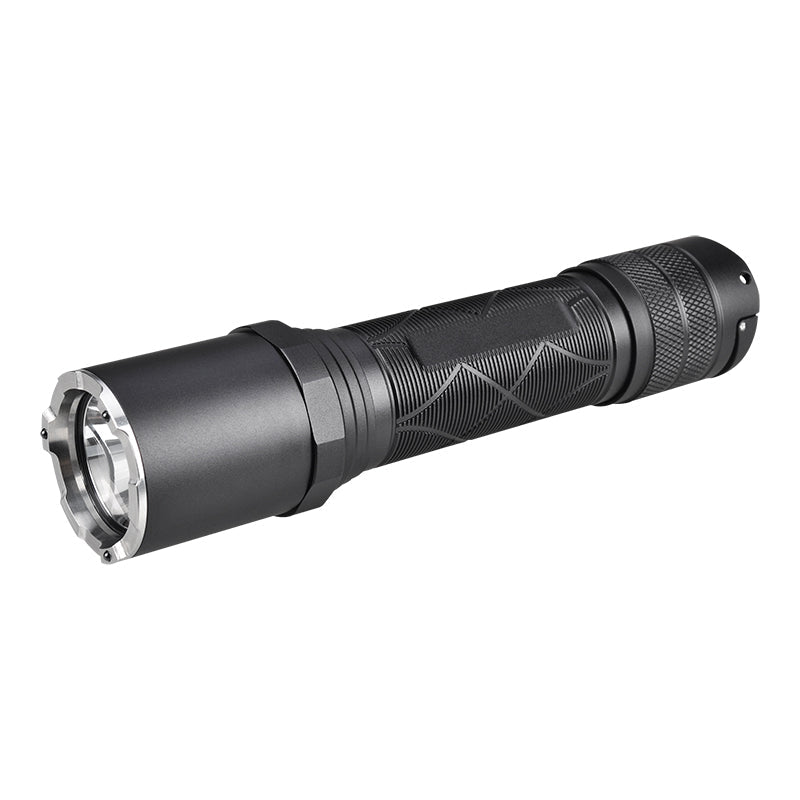
When comparing a weapon light vs tactical flashlight for farm security, our recommendation is straightforward: make a handheld tactical flashlight your primary portable light for routine checks. A weapon-mounted light serves a narrower purpose and should never replace an independent flashlight for inspecting unfamiliar movement, checking livestock, or identifying visitors.
At RichFire®, we bring 12 years of experience selling weapon lights, high-performance tactical flashlights, and laser aiming devices, alongside experience in product design, precision manufacturing, and rigorous testing. Our perspective starts with the job—not the largest brightness figure.
For farm owners, useful lighting must reveal hazards, support everyday work, and remain dependable through long nights. This guide explains the differences, the specifications worth comparing, and a practical way to evaluate your next light.

Weapon Light vs Tactical Flashlight: The Essential Differences
A weapon light is designed to attach to a compatible firearm. A handheld tactical flashlight operates independently, making it suitable for a much wider range of inspection and maintenance tasks.
“Tactical” does not automatically mean brighter, safer, or more durable. Compare documented performance and construction rather than relying on the product category alone.
| Comparison point | Weapon light | Handheld tactical flashlight |
|---|---|---|
| Primary role | Firearm-mounted illumination | Independent portable illumination |
| Routine farm inspections | Not an appropriate general inspection tool when mounted | Suitable for paths, gates, buildings, and equipment |
| Direction of illumination | Linked to firearm orientation | Independent of any firearm |
| Everyday versatility | Specialized | Broad |
| Important buying checks | Documented compatibility, controls, testing, and battery requirements | Beam pattern, sustained output, controls, and battery requirements |
| Main limitation | Cannot replace safe, independent observation | Occupies a hand unless separately supported |
The central distinction is independent illumination. A handheld light lets you inspect something without pointing a firearm toward it.
Why a Handheld Tactical Flashlight Comes First
Identify ordinary problems without introducing firearm risk
A noise near a barn might come from a loose door, an animal, a worker, or damaged equipment. The initial task is observation—not confrontation.
Fundamental firearm-safety guidance requires keeping the muzzle pointed in a safe direction and never pointing a firearm at anything you do not intend to shoot. That principle makes a mounted weapon light unsuitable as your everyday searchlight.
A handheld flashlight separates the need to see from the presence of a firearm. It is therefore the more appropriate first purchase for most routine farm-security lighting needs.
Support the work that continues after the inspection
Farm checks often become practical jobs:
-
Reading an equipment label.
-
Examining a damaged latch.
-
Checking a water connection.
-
Finding dropped keys.
-
Looking for an obstruction on a walking route.
A handheld tactical flashlight can support these tasks without involving firearm handling. When both hands are needed, a suitable headlamp or work light is a useful additional tool.
Keep suspicious-activity responses focused on safety
If you suspect an intruder, avoid approaching or attempting to clear buildings yourself. Move to a safe location and contact local authorities.
Portable lighting is an observation tool, not a substitute for a safe response plan.
Where a Weapon Light Fits—and Where It Does Not
A weapon-mounted light is a specialized accessory for lawful firearm use. Whether it belongs in your equipment depends on local law, appropriate training, and your circumstances.
It does not replace:
-
A handheld flashlight.
-
Positive identification and sound judgment.
-
Safe firearm storage.
-
Professional instruction.
-
A plan for contacting emergency services.
For buyers who have an appropriate lawful requirement, compatibility matters. Confirm the exact firearm model, mounting interface, manufacturer instructions, and approved battery configuration before purchasing.
Avoid assuming that a similar-looking mount guarantees compatibility. Likewise, a laser aiming device is not an area-lighting tool and cannot replace the illumination needed to understand a scene.

Comparing Light Performance for Real Farm Conditions
Lumens: total output, not the whole answer
Lumens describe total light output. They do not, by themselves, tell you whether a flashlight will provide useful visibility across an open yard or comfortable illumination inside a workshop.
A high-output light may distribute illumination broadly. Another light may concentrate more of its output into a narrower beam.
For close inspections, controllable brightness and useful spill can matter more than the highest advertised lumen figure.
Candela: intensity in the beam’s brightest area
Candela describes luminous intensity, commonly reported for the brightest part of a flashlight beam.
Higher candela generally indicates a more concentrated central beam, which can help illuminate distant objects. However, a tight hotspot may provide less convenient coverage for nearby tasks.
For a farm-security flashlight, assess both the central hotspot and the surrounding spill. You need to see the object of interest and the ground around it.
Beam distance: a standardized threshold, not guaranteed identification
Under the FL 1 performance framework described by Streamlight, beam distance is measured at the point where illumination reaches 0.25 lux.
That is a measurement threshold—not a promise that you can reliably identify a person, animal, or damaged gate at the advertised distance.
Weather, background contrast, obstructions, and your eyesight affect what you can actually recognize. Treat beam distance as a comparison figure, then evaluate useful visibility on your property.
Runtime: ask what remains after the initial brightness
FL 1 runtime is measured until output falls to 10% of its initial measured value.
Consequently, a multi-hour runtime claim does not necessarily mean the light maintains its starting brightness for several hours.
Ask for:
-
Runtime at the mode you expect to use.
-
An output-versus-time graph.
-
Information about brightness step-down.
-
The battery type used during testing.
For extended checks, sustained output is more informative than a brief maximum-output claim.
Match the Beam to Your Farm’s Lighting Zones
There is no universal “best flashlight for farm security.” Different locations create different visibility requirements.
| Farm location | Main visibility need | Feature to prioritize |
|---|---|---|
| Workshop or machinery shed | Nearby detail and broad coverage | Useful spill and lower-output modes |
| Yard and access gate | Ground awareness plus intermediate-distance visibility | Balanced hotspot and spill |
| Open approach or distant boundary | More concentrated illumination | Higher candela, evaluated at the actual distance |
| Extended maintenance task | Consistent working light | Sustained output and practical battery capacity |
| Classified hazardous location | Appropriate ignition protection | Equipment approved for that specific environment |
These are selection priorities, not guaranteed specifications. Building layout, vegetation, reflective surfaces, and actual inspection distances should shape the final choice.
An Often-Missed Issue: Farm Hazards Beyond Darkness
Rugged construction is not hazardous-location approval
Grain dust and flammable vapors introduce risks that ordinary durability claims do not address.
OSHA identifies agricultural facilities with excessive combustible dust among locations that may require hazardous-location classification. Electrical equipment must be suitable for the particular classified environment.
A light described as waterproof, impact-resistant, or tactical is not automatically approved for those conditions.
Where combustible dust or flammable atmospheres may exist, obtain a qualified assessment and select equipment with the appropriate approval. Do not assume an ordinary tactical flashlight is suitable.
Inspect the details behind durability claims
Before purchasing, request documentation covering:
-
Water-resistance test conditions.
-
Impact-testing conditions.
-
Operating-temperature limits.
-
Battery and charging requirements.
-
Replacement parts and service procedures.
Ask how performance was measured rather than treating “heavy-duty” as evidence.
This is also where ownership support matters. A clearly explained return policy and warranty can reduce purchasing uncertainty, but neither replaces documented performance.
A Five-Step Farm Flashlight Evaluation
The following is a proposed buyer evaluation—not a claim that RichFire® has conducted a comparative farm trial.
1. Define three ordinary inspection tasks
Choose representative jobs, such as checking a gate latch, reading an equipment label, and viewing an approach from a safe location.
Use familiar, non-sensitive objects. Keep firearms entirely outside this flashlight assessment.
2. Compare lights under similar conditions
Evaluate candidates from the same locations, in comparable weather, using fully charged or fresh manufacturer-approved batteries.
Avoid judging one light immediately after looking directly into another bright beam.
3. Check useful detail, not just apparent brightness
Record whether you can distinguish the latch position, read the label, and see obstacles on the walking route.
A visually impressive beam is not necessarily the most useful working beam.
4. Repeat after a normal inspection period
Repeat your observations after the light has operated for the duration of a typical check.
Note whether useful visibility changes and whether the controls remain comfortable to operate.
5. Keep a simple comparison sheet
Score each candidate for:
-
Detail visibility.
-
Ground coverage.
-
Control usability with work gloves.
-
Brightness consistency.
-
Battery convenience.
This creates a property-specific buying record instead of relying solely on promotional specifications.
Build Farm Security Around More Than Portable Lights
A flashlight helps when someone is present to use it. It cannot secure an unattended entrance or record an incident by itself.
The National Farmers’ Union recommends measures including locked gates, secured buildings, security lighting, alarms, and surveillance.
A practical investment order is:
-
Repair obvious access-control weaknesses.
-
Improve fixed lighting where appropriate.
-
Add suitable alarms or camera coverage.
-
Equip workers with dependable portable lights.
-
Review reporting procedures and emergency contacts.
These measures perform different jobs. Locks restrict access, cameras provide monitoring or evidence, and portable lights support inspection. One should not be presented as a replacement for another.
Choosing Your Next Light from RichFire®
Our buying recommendation is to start with your most frequent task, inspection distance, and expected operating time.
For routine farm checks, prioritize a handheld tactical flashlight with a useful beam, straightforward controls, and documented performance. Consider specialized accessories only when they address a genuine, lawful requirement.
RichFire® offers a 30-day return period and a two-year warranty. Review the applicable terms before ordering, including return conditions and warranty coverage.
Explore RichFire® tactical flashlights for everyday farm inspections, or contact our team with your working distances, typical tasks, and battery preferences. Request model-specific specifications before choosing, rather than assuming every light in a category performs alike.

Frequently Asked Questions
Is a weapon light better than a tactical flashlight for farm security?
Not for general inspections. A handheld tactical flashlight provides illumination independently of a firearm, making it the more appropriate primary portable light for checking gates, buildings, equipment, and unfamiliar movement.
How many lumens do I need for a farm-security flashlight?
There is no single requirement for every property. Compare beam distribution, candela, working distance, and sustained output alongside lumens. Test whether the light reveals useful detail at your actual inspection locations.
Does a longer advertised beam distance mean better identification?
No. Standardized beam distance describes a light-level threshold. It does not guarantee recognition of a person or animal at that distance. Conditions and contrast materially affect useful visibility.
Can a laser sight replace a flashlight?
No. A laser aiming device does not provide the broad illumination needed to inspect surroundings, recognize obstacles, or understand a scene. It is not a substitute for a handheld inspection light.
Are tactical flashlights safe around grain dust?
Do not assume so. Where a location is classified as hazardous, equipment must be suitable for that specific environment. Ordinary water resistance or impact resistance does not establish ignition protection.
Should I choose rechargeable or replaceable batteries?
Choose based on manufacturer compatibility and your charging arrangements. Rechargeable options can suit regular use; approved replaceable batteries may suit some backup plans. Follow the product instructions and do not substitute unsupported battery types.
References
1. National Shooting Sports Foundation – "Firearm Safety—10 Rules of Safe Gun Handling" – Basis for muzzle-direction and identification principles. https://www.nssf.org/safety/rules-firearms-safety/
2. Streamlight – "ANSI Information" – Definitions of light output, peak beam intensity, beam distance, and runtime under the referenced FL 1 framework. https://www.streamlight.com/resources/learning/ansi-information
3. Streamlight – "Candela vs Lumens" – Explanation of output, beam concentration, and application-dependent selection. https://www.streamlight.com/community/blog/blogs/2024/08/05/candela-vs-lumens
4. Occupational Safety and Health Administration – "29 CFR 1910.307—Hazardous (Classified) Locations" – Requirements concerning equipment suitability in classified environments. https://www.osha.gov/laws-regs/regulations/standardnumber/1910/1910.307
5. National Farmers' Union – "How to Prevent Theft on Farm" – Guidance on gates, machinery security, lighting, CCTV, and alarms. https://www.nfuonline.com/news/theft-on-farm-guidance-and-support/
Hot Tags: Weapon Light, Tactical Flashlight, Weapon Mounted Light, Farm Security Lights, Rechargeable Tactical Flashlight, High Lumen Flashlight, Long Range Flashlight, Waterproof Tactical Flashlight, Handheld Tactical Flashlight, Best Flashlight For Farm Security